
The U.S. defense industrial base moves at the speed of paperwork. If you’ve never had reason to care about that fact, consider this: a small manufacturer in Ohio with the exact components the Department of Defense needs right now will spend months sometimes years navigating procurement channels before a single contract lands.
Meanwhile, the Pentagon keeps paying legacy primes like Lockheed Martin and Raytheon to do the same work, at inflated cost, through processes built in the 1980s.
The system doesn’t work well. Everyone in it knows it doesn’t work well. And almost nobody has done anything about it.
Kaya Celebi thinks he knows why. And he thinks he can fix it.
Celebi is 25, based in New York, and the kind of person who seems to generate more projects than most people have ideas.
By the time he was finishing his Master’s at Columbia, he’d already co-founded a student matchmaking app, published open-source Python tools used by developers worldwide, filed a patent for a drone-based plant watering system, and spent two years as a data scientist at Morgan Stanley.
He’s the kind of resume that reads like someone tried to pack a decade into a few years and mostly succeeded.
But none of that is what he actually wants to talk about. What he wants to talk about is GUILD.
When the Supply Chain Is the Weak Link
To understand what GUILD is building, you first have to understand what “defense contracting” actually means at the operational level not the Lockheed Martin level, not the congressional budget level, but the factory floor level.
The U.S. defense supply chain is, in Celebi’s words, “too slow, too manual, and too hard to navigate.” That’s an understatement dressed up as a talking point.
The reality is that the Department of Defense relies on a sprawling network of small and mid-size manufacturers who make everything from specialized metal components to sensor housings to circuit assemblies.
These manufacturers are often excellent at what they do. What they’re terrible at by no fault of their own is the labyrinthine process of getting government work in the first place.
Procurement regulations, compliance requirements, security clearances, certification paperwork the barrier to entry is so high that capable manufacturers simply give up, or never try at all.
The government ends up paying more, getting less, and concentrating risk in a handful of massive primes who themselves subcontract work out anyway. It’s a middleman problem masquerading as a security feature.
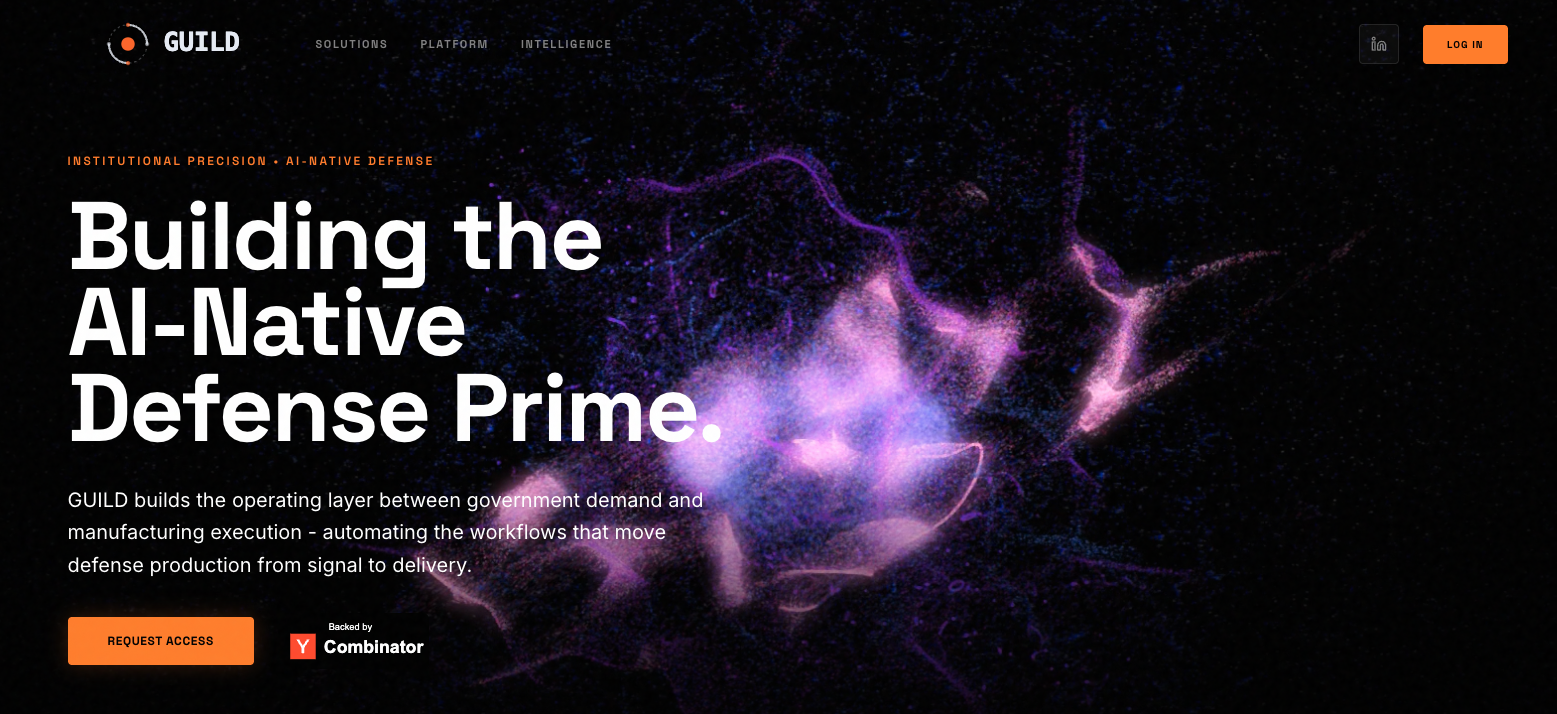
Celebi’s framing of GUILD as “the first AI-native defense contracting agency a Neoprime” is deliberate. A “Neoprime” isn’t a word you’ll find in defense industry jargon, and that’s the point.
It’s a new category: not a traditional prime contractor bidding on single programs, not a staffing agency placing bodies in defense offices, but an intelligent layer that matches fragmented government demand to real manufacturing capacity at scale, in near-real time.
The vision, as Celebi describes it, is to make defense supply chains “move at software speed.” That phrase sounds like startup-speak until you consider what it would actually mean in practice. A procurement cycle that currently takes months, compressed to days.
Supplier matching that currently requires an insider network, made accessible to any qualified manufacturer. Contract compliance documentation that currently buries small businesses, handled automatically. It’s a large lift. But the underlying technology, he argues, has finally caught up to the ambition.
From Wall Street to War-Ready Supply Chains
Celebi’s path to GUILD doesn’t follow the usual defense-sector pipeline. He didn’t come up through a think tank, a government internship, or the ranks of a prime contractor. He came through finance and software and that unusual combination is, arguably, exactly what the problem needs.
After finishing his undergraduate CS degree at Duke, Celebi joined Morgan Stanley as a Technology Analyst, eventually moving into data science work as a Technology Associate.
His time there wasn’t about learning to build financial models it was about learning how large, regulated, risk-averse institutions actually process information, make decisions under uncertainty, and move capital through complex systems.
That’s not an obvious credential for defense contracting. But it turns out the Pentagon and a major investment bank have more in common than you’d think: both are enormous institutions drowning in data, slow to digitize, and deeply resistant to change from the outside.
“I spent two years watching incredibly smart people move slowly because the infrastructure underneath them was built for a different era,” he says, describing his time in finance. He doesn’t mean it as a criticism. He means it as a pattern. And GUILD, in many ways, is his attempt to build what neither institution built for itself.
He left Morgan Stanley for a role as an AI Application Developer at Hartree Partners, a commodities and energy trading firm, where he spent a year building AI systems in a domain physical commodity markets that shares meaningful structural overlap with defense supply chains.
Both involve physical goods, logistics complexity, regulatory constraints, and the challenge of pricing risk on assets that don’t trade cleanly on any exchange. That year, by most accounts, sharpened his technical toolkit considerably.
By January 2026, he was done working for other people. GUILD was incorporated. He went full-time. And sometime in the first half of 2026, Y Combinator agreed.
What It Means That Y Combinator Bet on This
Y Combinator acceptance is not a guarantee of anything. The S26 cohort alone contains dozens of companies, many of which will not exist in five years. But it does mean something specific: a room full of people who have seen thousands of early-stage companies looked at GUILD and said, “this has a real shot.”
That’s notable in a category that YC has historically approached with caution. Defense tech is regulated, politically sensitive, capital-intensive, and characterized by sales cycles measured in years rather than months.
Y Combinator has backed defense-adjacent companies before Anduril’s founders had YC connections, and the accelerator has shown increasing interest in defense infrastructure since the Department of Defense began signaling more openness to commercial vendors after 2022 but it remains a category where the wrong approach kills companies fast.
The fact that GUILD’s angle is supply chain and procurement, rather than weapons systems or surveillance technology, matters too. The ethical surface area is smaller.
The customer base is broader. And the problem how government and industry actually connect is one that both sides of the political aisle agree is broken.
“If you’re a mid-size manufacturer and you’ve got the capacity to serve defense contracts,” Celebi says, “the system right now basically asks you to become a compliance expert before you can do any actual work. We’re trying to flip that.”
The AI Layer the Pentagon Has Been Missing
GUILD’s technical approach draws on everything Celebi has built over the past several years and some of it you can actually see on his GitHub profile, where open-source projects like a RISC-V assembler in Python and flight data scraping tools demonstrate a builder who thinks in systems, not just features.
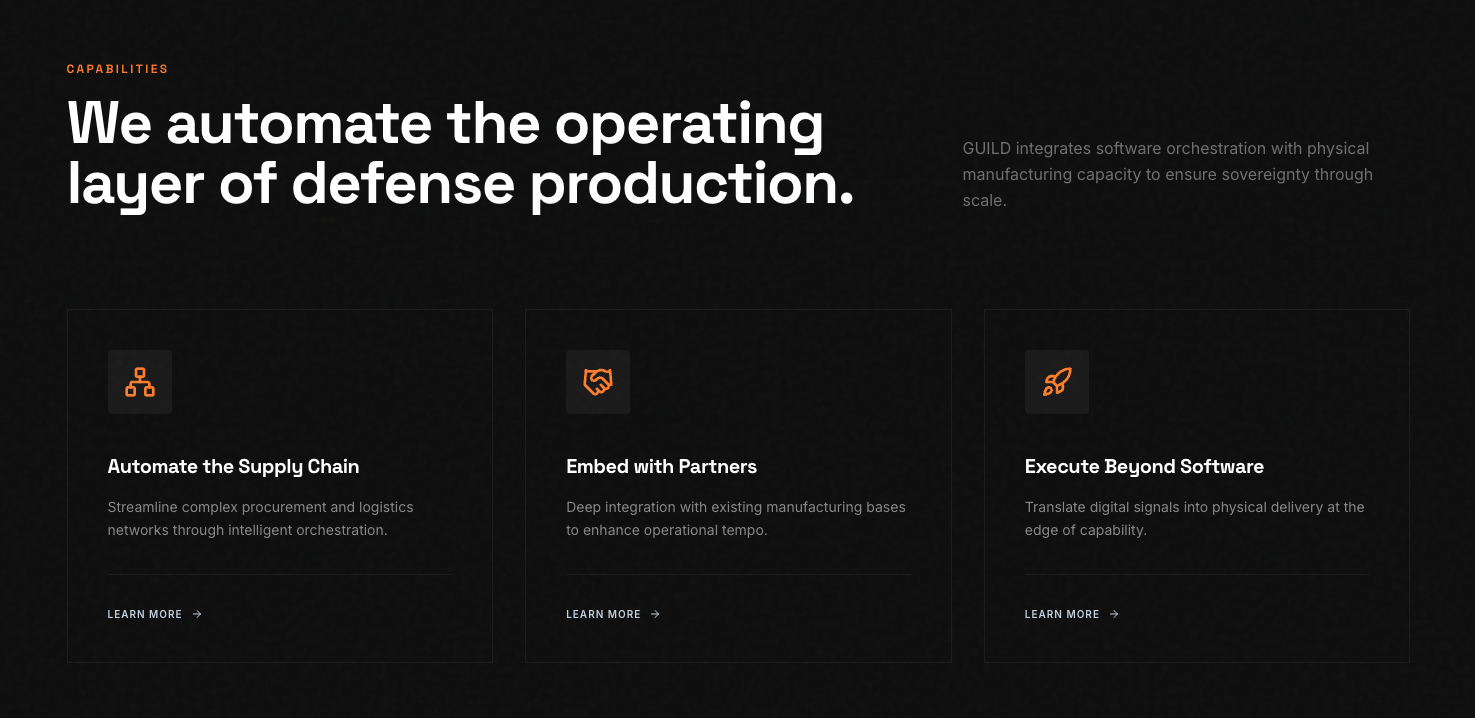
The core GUILD product, as described on guildai.co, is an AI-native agency that sits between government procurement demand and the manufacturing supply base. Think of it less like a software company and more like an intelligent broker one that doesn’t sleep, doesn’t lose paperwork, and doesn’t need six months to figure out which supplier can fill a given order.
On the demand side, GUILD ingests fragmented government contracting data solicitations, program requirements, historical awards and uses machine learning to identify patterns and predict which opportunities are likely to be awarded, in what timeframe, and at what price range.
On the supply side, GUILD builds relationships with manufacturers and maintains a structured understanding of their capabilities, certifications, and capacity. The matching layer in the middle is where the AI work lives: connecting real demand to real capability faster and more accurately than any human brokerage network could.
It’s a model that borrows from Flexport‘s approach to freight forwarding, Palantir‘s approach to data integration in defense contexts, and the broader playbook of companies that have digitized analog industries by becoming the connective tissue rather than the end product.
The analogy that comes up most in conversations about GUILD is what Stripe did for internet payments: it didn’t replace banks, it built the layer that made transacting with banks frictionless. GUILD is attempting something similar for the most friction-heavy commercial relationship in America.
What Could Go Wrong and Why Celebi Isn’t Ignoring It
No piece about a YC-backed defense startup would be honest without acknowledging what could go wrong. And there’s quite a bit.
Defense procurement reform has a long and unimpressive track record. The Government Accountability Office has been publishing reports about acquisition inefficiency since at least the 1980s.
The Defense Innovation Unit was created specifically to help commercial vendors navigate the DOD, and it has had mixed results. The problem isn’t ignorance it’s institutional inertia.
The question for GUILD is whether AI changes the equation enough to actually break through, or whether the same forces that slowed every previous reform effort will slow this one too.
There’s also the question of trust. Defense procurement isn’t just inefficient it’s deliberately slow, because speed creates security risk. Matching a manufacturer to a contract faster than a human would means relying on algorithmic vetting, which means making assumptions about what matters in the vetting process.
That’s a technical challenge, but it’s also a political one. If GUILD’s AI recommends a supplier who turns out to have a security vulnerability physical, cyber, or otherwise the company doesn’t just lose a customer. It loses its right to operate in the space entirely.
Celebi doesn’t hand-wave these risks away. “The compliance piece is genuinely hard,” he’s said publicly. “We’re not trying to cut corners on it. We’re trying to make it faster for the people doing it right.”
That framing GUILD as an accelerator for the compliant, not a bypass for the non-compliant is the right one strategically. Whether it holds up at scale is something only time will answer.
Why the Defense Industrial Base Matters Right Now
The timing of GUILD’s launch is not accidental. The past three years have made the fragility of Western defense supply chains impossible to ignore. The war in Ukraine exposed munitions production bottlenecks that NATO hadn’t planned for.
Semiconductor dependencies made explicit just how concentrated and therefore vulnerable the industrial base for critical defense components had become.
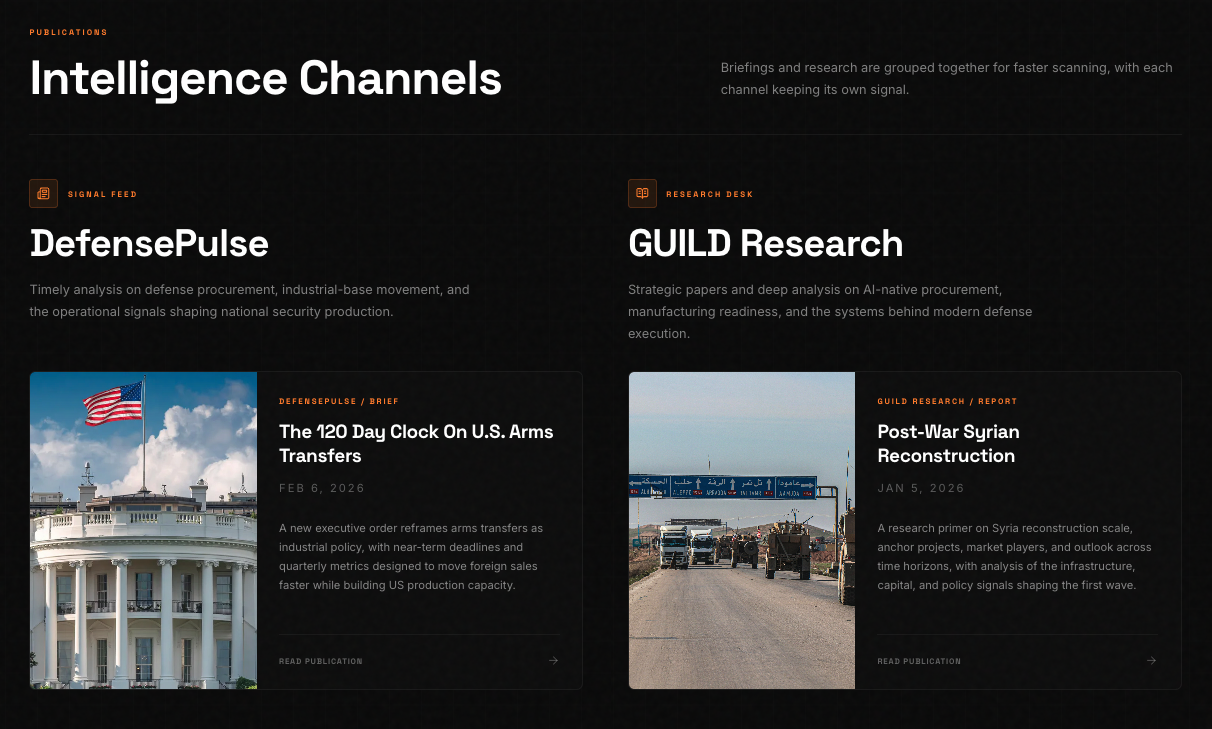
The White House’s supply chain executive orders since 2021 have signaled that reshoring and diversification are no longer optional policy preferences they’re national security imperatives.
That context changes the market for what GUILD is building. A few years ago, pitching “AI-native defense contracting” to a government procurement officer would have earned polite skepticism.
Today, the same officer has likely sat in briefings about industrial base vulnerability and is actively looking for ways to onboard more suppliers faster. The demand signal from the government side is real in a way it hasn’t been before.
The investment thesis around defense tech more broadly has shifted accordingly. Firms like a16z, Founders Fund, and Shield Capital have all made explicit bets that the next decade of defense modernization will be driven by software companies, not traditional primes. GUILD fits that thesis precisely.
What Kind of Founder Is Kaya Celebi, Really?
Cover stories tend to flatten founders into archetypes: the visionary who saw what others missed, the scrappy underdog who outworked everyone, the technical genius who built what couldn’t be built. Celebi is genuinely harder to categorize than that.
The breadth of his background patents, open-source tools, a matchmaking app, finance, commodity trading, and now defense tech suggests someone who is constitutionally unable to commit to just one thing.
That can be a weakness in founders. Startups die from distraction more than from competition.
But it can also be a signal of something rarer: a builder who is genuinely curious about how systems work, across domains, and who looks for the structural patterns that repeat across industries.
If you squint at GUILD with that lens, it starts to look less like a defense startup and more like a systems problem that happens to be expressed in the defense industry right now.
The question that matters for GUILD isn’t whether Celebi is smart enough he clearly is. It’s whether he can build a company that navigates the specific combination of technical, regulatory, and political complexity that defense procurement demands.
That requires a kind of patience and institutional literacy that pure technical talent doesn’t guarantee. The Morgan Stanley years may matter more for this than any of his engineering credentials.

Stravyn Hill
https://stravynhill.comYour Partner in Progress
Great content! Keep up the good work!
Thank you! 🙌
Really appreciate the support more valuable content coming your way!